✨ This article was AI edited. Editorial responsibility: VinCheckGermany.eu.
A VIN check in Germany is an official automotive audit that decodes a 17-digit chassis number to verify title authenticity, technical inspection records (TÜV/DEKRA), and manufacturer service campaigns. This forensic evaluation detects odometer tampering on exported German automobiles, uncovers concealed collision damage, and confirms unencumbered ownership before signing a purchase agreement.
The German automotive marketplace stands as the premier destination for international pre-owned vehicle buyers seeking precision engineering, high-specification trim packages, and well-maintained motor cars. However, acquiring an automobile in the Federal Republic of Germany requires conducting a systematic vin check germany verification to avoid the legal and financial perils associated with cross-border vehicle transactions.
German Vehicle Identification Standards and Legal Framework
In German jurisprudence, the Vehicle Identification Number is designated as the Fahrzeug-Identifizierungsnummer (FIN). Under federal traffic regulations administered by the Federal Ministry of Digital and Transport (BMDV), every motor vehicle must possess an indelible FIN physically stamped into a load-bearing chassis component.
When conducting a professional VIN check in Germany, verifying that the stamped FIN matches all accompanying paperwork is mandatory. Under Section 267 of the German Criminal Code (StGB), forging or tampering with vehicle identification numbers constitutes criminal forgery (Urkundenfälschung), punishable by imprisonment.
Deciphering German Automaker WMI and Assembly Codes
German vehicle manufacturers embed precise factory identification data within the standard 17-character ISO 3779 architecture:
| Manufacturer | WMI Sequence | Headquarters & Jurisdiction | Key Diagnostic Characteristics |
|---|---|---|---|
| BMW AG | WBA, WBS | Munich, Bavaria | WBS explicitly denotes bespoke high-performance chassis manufactured by BMW M GmbH. |
| Mercedes-Benz | WDB, WDD, WDC | Stuttgart, Baden-Württemberg | Encodes chassis sub-generation (e.g., W213 E-Class, W223 S-Class) in positions 4 through 6. |
| Volkswagen AG | WVW, WV1, WV2 | Wolfsburg, Lower Saxony | WV1 and WV2 designate Volkswagen Commercial Vehicles (Transporter, Crafter, Caddy). |
| Audi AG | WAU, WUA | Ingolstadt, Bavaria | WUA designates Audi Sport GmbH (RS models, R8 supercar). |
| Porsche AG | WP0, WP1 | Stuttgart-Zuffenhausen | WP0 designates sports car unibodies (911, 718 Boxster/Cayman); WP1 denotes Cayenne/Macan SUVs. |
The Three Pillars of German Vehicle Verification
An exhaustive digital and physical VIN check in Germany synthesizes information across three foundational data repositories:
1. Periodic Roadworthiness Records (HU/AU Reports)
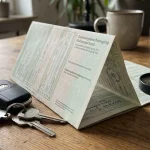
In Germany, the periodic vehicle inspection (Hauptuntersuchung) is legally required every 24 months. Conducted by authorized engineering testing associations (TÜV SÜD, TÜV NORD, TÜV Rheinland, DEKRA, GTÜ), every test generates a physical certificate stating the exact odometer mileage to the single kilometer. Cross-referencing consecutive test certificates guarantees that the odometer has not suffered manipulation.
2. Federal Motor Transport Authority Data (KBA Registries)
The Kraftfahrt-Bundesamt (KBA) tracks all safety recalls and environmental compliance actions across Germany. A comprehensive VIN lookup verifies whether the vehicle chassis has outstanding mandatory safety recall campaigns that could result in registration revocation if left unaddressed.
3. Digital Service Records (Digitaler Servicenachweis)
Modern German automakers store scheduled maintenance history on secure corporate servers rather than paper logbooks. Authorized franchised service workshops record repair orders, fluid exchanges, brake pad wear percentages, and diagnostic telemetry indexed directly to the vehicle’s VIN.
Detecting Concealed Accident Damage and Structural Compromise
German consumer protection law explicitly differentiates between an unfallfreies Fahrzeug (guaranteed accident-free vehicle) and a vehicle that has suffered prior impact damage (Unfallwagen). Sellers who deliberately conceal structural repairs are guilty of contractual fraud (Arglistige Täuschung).
When inspecting a pre-owned vehicle in Germany, implement this four-point forensic inspection routine:
- Ultrasonic Paint Thickness Measurement: Measure paint depth across all exterior panels. Original factory paint from German assembly lines measures between 90 μm and 130 μm. Any reading above 250 μm indicates repainting, while measurements exceeding 500 μm reveal the application of polyester body filler over damaged sheet metal.
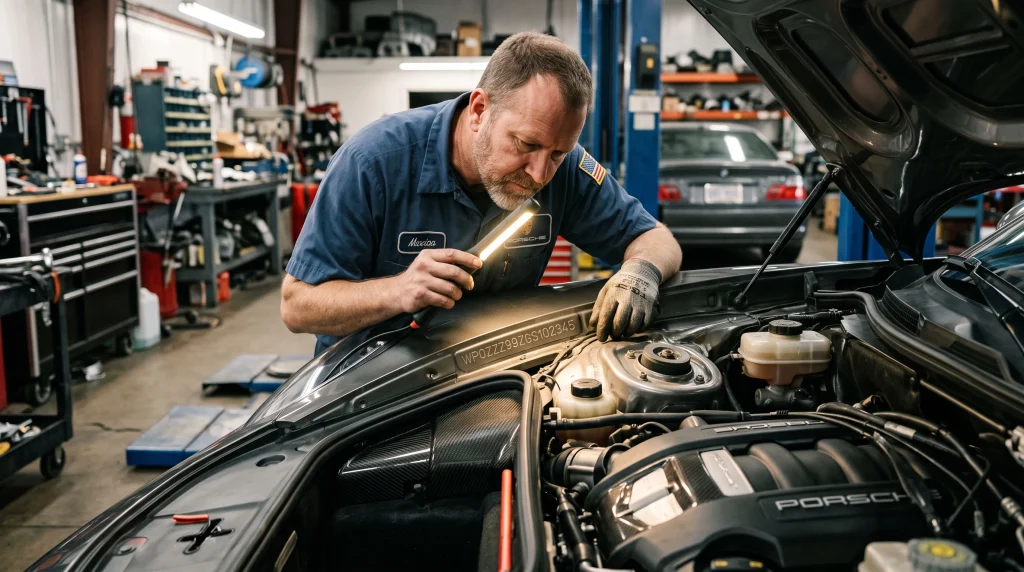
- Chassis Stamping Integrity: Verify the mechanical stamping on the firewall or right suspension strut mount. The letters and numbers must exhibit clean, laser-cut edges with consistent vertical alignment and factory electro-coat primer.
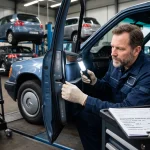
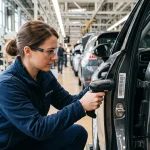
- Holographic B-Pillar Data Label: Inspect the black tamper-evident label on the door pillar. If the sticker has been peeled, replaced with a generic label, or exhibits jagged border cuts, the vehicle may have undergone substantial B-pillar collision reconstruction.
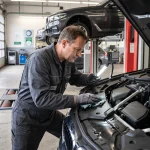
- OBD-II Telemetry Readout: Connect an automotive diagnostic scanner to query the electronic control units (ECUs). Check that the electronic VIN stored in the transmission controller (TCU), instrument cluster (KOMBI), and airbag module matches the mechanical firewall stamping.
Frequently Asked Questions
Is a German VIN check legally binding?
A vehicle history report provides forensic intelligence and documentation proof, but purchase protection relies on the written sales contract (Kaufvertrag). Ensure the contract explicitly specifies that the vehicle is unfallfrei and guarantees the accuracy of the displayed odometer reading.
Can I verify a German VIN before traveling to Germany?
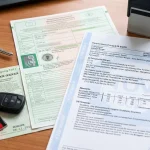
Yes. Requesting the 17-digit VIN and high-resolution photographs of Zulassungsbescheinigung Teil I from the selling dealership enables you to run comprehensive online registry checks, verify recall completion with manufacturer customer support, and validate dealer legitimacy before booking international travel.
Get our latest guides, news, and insights highlighted in your Google Search & AI Overviews.