✨ This article was AI edited. Editorial responsibility: VinCheckGermany.eu.
Produced with AI. This article was artificially generated. Editorial responsibility: VinCheckGermany.eu.
German car VIN verification audits a vehicle’s 17-character chassis number across German state vehicle registries (ZFZR), manufacturer build sheets, and European insurance claim databases. This methodical inspection verifies factory options, detects odometer manipulation on exported German automobiles, and confirms that title documentation (Fahrzeugbrief) is authentic before money changes hands.
Germany produces some of the most engineered, reliable, and technologically advanced passenger vehicles in automotive history. From the precision-machined inline-six powerplants of BMW to the robust galvanized unibodies of Audi and Volkswagen, acquiring a pre-owned German motor car is a dream for driving enthusiasts worldwide. However, ensuring you receive an authentic, unmolested automobile requires executing a rigorous vin number check germany inspection protocol before executing contract signatures.
The Structural Anatomy of German VIN Numbering
Automobile manufacturers headquartered in Germany adhere rigidly to international standard ISO 3779 while implementing brand-specific descriptor methodologies in their Vehicle Descriptor Sections (positions 4 through 8):
1. World Manufacturer Identifier (WMI) Signatures
The first three characters immediately establish whether the chassis was manufactured on German soil:
WBA/WBS: BMW AG Munich (WBS indicates BMW M GmbH performance models).WAU/WUA: Audi AG Ingolstadt (WUA indicates Audi Sport GmbH / Quattro).WDB/WDC/WDD: Mercedes-Benz Group AG Stuttgart.WVW/WVG: Volkswagen AG Wolfsburg (WVG denotes Volkswagen SUVs).WP0/WP1: Dr. Ing. h.c. F. Porsche AG Stuttgart.
2. The Factory Assembly Plant Code (Character 11)
Character 11 pinpoints the exact assembly factory where the chassis unibody was welded and painted:
| Brand | Plant Character | Assembly Facility Location | Primary Assembled Model Lines |
|---|---|---|---|
| BMW | A, F, K | Munich (A), Dingolfing (F), Leipzig (K) | 3 Series, 5 Series, 7 Series, 8 Series, i4 |
| Audi | A, N, D | Ingolstadt (A), Neckarsulm (N), Győr Hungary (D) | A3, A4, A6, A8, TT, R8 |
| Volkswagen | W, E, H | Wolfsburg (W), Emden (E), Hanover (H) | Golf, Passat, Arteon, Transporter/Multivan |
| Mercedes-Benz | A, F, R | Sindelfingen (A), Bremen (F), Rastatt (R) | E-Class, S-Class, C-Class, A-Class |
Verifying German Vehicle Registration Certificates
When purchasing an automobile in Germany, the seller must deliver two security documents printed by the federal printing office (Bundesdruckerei):
1. Zulassungsbescheinigung Teil I (Fahrzeugschein)
Ensure that the watermarked green document contains no mechanical erasure marks. Field E must match the VIN stamped into the metal firewall. Field 2.1 (HSN) and Field 2.2 (TSN) encode the manufacturer and model type. Cross-referencing these numbers against German automotive insurance directories confirms the vehicle’s exact displacement and horsepower tier.
2. Zulassungsbescheinigung Teil II (Fahrzeugbrief)
The ownership title document. Inspect the total count of previous owners (Anzahl der Vorhalter). If a car listing advertised “1 previous owner” but Teil II indicates 3 or 4 historical registrations, the discrepancy indicates fleet or rental usage that must be clarified.
Digital Service Records (Digitaler Servicenachweis)
Since the mid-2010s, German premium brands (BMW, Audi, Mercedes-Benz, Porsche) completely transitioned from paper service booklets to cloud-synchronized Digital Service Records. All maintenance intervals, brake fluid flushes, oil service milestones, and workshop repair orders are encrypted directly into the automaker’s central database.
When executing a VIN number check in Germany, ask the seller to obtain an official printout of the digital service report from an authorized franchised dealership. Every record entry contains:
- The exact servicing dealership identifier code (Betriebsnummer).
- Timestamped date and exact vehicle mileage at check-in.
- Specific factory inspection checklists fulfilled according to manufacturer service schedules.
Forensic Metal Chassis Verification: Spotting VIN Cloning
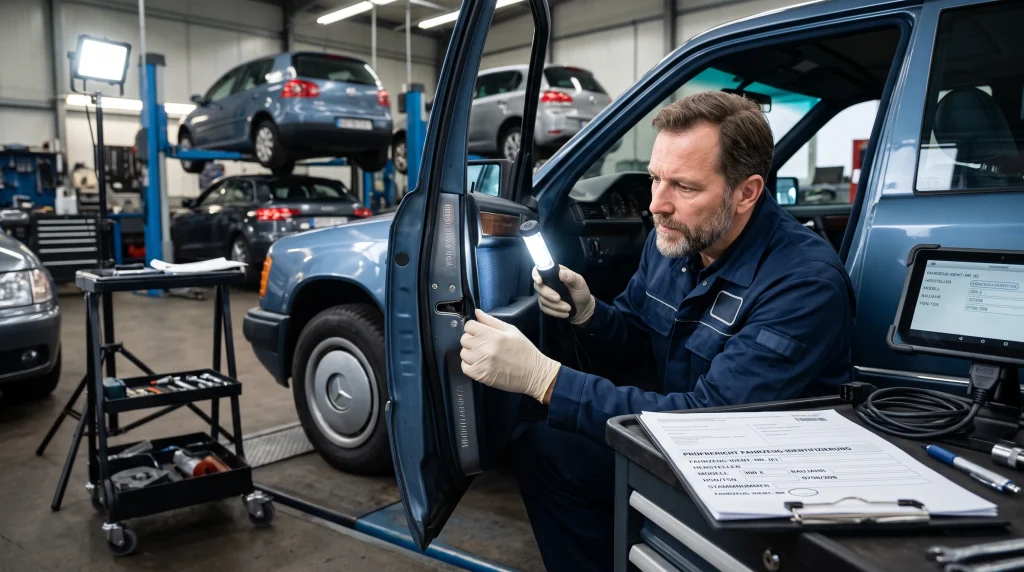
Criminal enterprises routinely steal vehicles in Western Europe, grind off the authentic VIN from the chassis leg, and weld in a salvage VIN harvested from a total-loss vehicle. When conducting an in-person vehicle examination:
- Examine Surrounding Metal: Feel the steel surrounding the stamped VIN on the right suspension turret or firewall. Factory stamping creates smooth indentation edges. Welded repair patches exhibit subtle surface ripples, uneven primer texture, or telltale heat discoloration under ultrasonic inspection.
- Inspect the Laser Barcode Decal: Check the tamper-evident B-pillar data label. Authentic German automaker decals utilize brittle holographic substrate designed to delaminate and disintegrate if peeled.
- ECU Electronic Match: Connect an OBD-II diagnostic reader to retrieve the electronic VIN stored in the Engine Control Module (DME/DDE), Transmission Control Module (TCU), and Instrument Cluster (KOMBI). If the electronic VIN differs from the firewall stamping, walk away immediately.
Frequently Asked Questions
Can a German VIN check reveal previous taxi or rental car usage?
Yes. Commercial vehicle history reports and registration documents distinguish between private owners and commercial rental entities (Selbstfahrervermietfahrzeug) or municipal taxi services, which operate under different mandatory 12-month inspection intervals.
What is the COC document in Germany?
The Certificate of Conformity (COC / EG-Übereinstimmungsbescheinigung) is a standardized document issued by the automaker verifying that the vehicle complies with all European Union type-approval standards, essential for importing the car into other EU member states without re-homologation testing.
Erhalten Sie unsere neuesten Ratgeber, News und Analysen hervorgehoben in der Google-Suche und in AI Overviews.