✨ This article was AI edited. Editorial responsibility: VinCheckGermany.eu.
When auditing a German vehicle’s history (historia pojazdu z niemiec), you query Poland’s CEPiK national portal, German TÜV inspection registers, and European insurance claim databases using a 17-character VIN. This forensic check verifies foreign registration dates, detects manipulated odometer readings, and identifies unrecorded collision write-offs before importing a pre-owned car from Germany.
The German pre-owned automobile marketplace is the primary source of personal and commercial motor vehicles imported into Poland, the Czech Republic, Slovakia, and across Central and Eastern Europe. With over one million vehicles imported annually, buyers seek high trim specifications, comprehensive dealer service logs, and superior highway maintenance. However, purchasing an imported vehicle without performing a verified historia pojazdu z niemiec exposes buyers to the rampant practices of digital odometer rollback, concealed accident repairs, and fraudulent title documentation.
Using Poland’s CEPiK Portal for Foreign Vehicle History Checks
The Ministry of Digital Affairs in Poland maintains the Central Register of Vehicles and Drivers (CEPiK), which includes the public vehicle lookup tool HistoriaPojazdu.gov.pl. While CEPiK was originally limited to domestically registered automobiles, the platform now features an integrated foreign data stream (Dane zagraniczne) powered by international databases:
- Access Requirements: To query a vehicle not yet registered in Poland, you must enter three data points: the 17-digit VIN (numer VIN), the foreign registration number (numer rejestracyjny), and the date of first registration (data pierwszej rejestracji) found on Field B of the German registration certificate.
- Foreign Risk Categories Reported: CEPiK queries external international partners (including CARFAX and autoDNA) to flag critical lifecycle warnings:
- Kradzież (Theft): Flags whether the chassis is recorded as stolen in international police registries across Europe and North America.
- Złomowanie (Scrapped / Salvage): Discloses whether an insurance consortium declared the vehicle a total constructive loss or ordered it to be dismantled for scrap metal.
- Powypadkowy (Accident-Damaged): Identifies whether the vehicle suffered significant collision damage that required an independent insurance adjuster’s appraisal.
- Przekręcony Licznik (Odometer Discrepancy): Highlights conflicting mileage records where a subsequent reading is lower than a previously certified inspection log.
The Four Pillars of German Vehicle History Documentation
A rigorous historia pojazdu z niemiec investigation cross-references four independent documentation pillars to guarantee complete transparency:
| Pillar | Official German Name | Core Data Captured | Import Verification Purpose |
|---|---|---|---|
| 1. Technical Inspection | HU/AU-Prüfbericht (TÜV, DEKRA, GTÜ) | Exact test date, recorded kilometer count, passed/failed safety categories, advisory mechanical notes. | Proves chronological mileage progression and roadworthiness under EU Directive 2014/45/EU. |
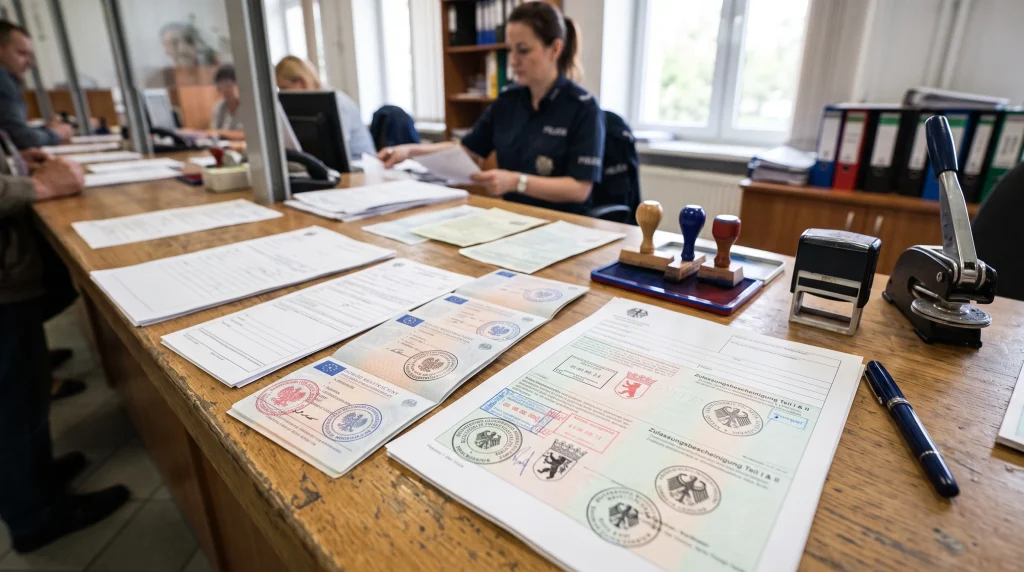
| 2. Registration Deed | Zulassungsbescheinigung Teil II (Fahrzeugbrief) | Historical number of owners (Vorhalter), dates of municipal ownership transfers. | Verifies seller honesty regarding private vs. commercial fleet or rental vehicle usage. |
| 3. Service History | Digitaler Servicenachweis (DSN) | Authorized franchised dealer maintenance invoices, warranty recalls, fluid exchanges. | Validates manufacturer warranty compliance and authenticates electronic service records. |
| 4. Export Clearance | Abmeldebescheinigung / Ausfuhrdokumente | Official municipal deregistration stamp (Außerbetriebsetzung) on Teil I. | Confirms the vehicle is legally unencumbered and clear for cross-border transit and title transfer. |
Combating Cross-Border Odometer Manipulation
Because vehicles leaving Germany exit the German registration register and do not enter the Polish CEPiK database until their first domestic roadworthiness inspection (badanie techniczne), dishonest intermediaries exploit this jurisdictional transition to adjust digital odometers. A vehicle with 310,000 km in Frankfurt can easily be rolled back to 165,000 km before crossing the border into Poland.
To identify manipulated odometers during your historia pojazdu z niemiec check:
- Verify Physical Paper TÜV Certificates: Demand the original physical inspection certificates from prior test intervals. Compare the handwriting, rubber stamps, and paper aging. Fraudulent sellers frequently forge single recent inspection sheets while destroying earlier reports that reveal true higher mileage.
- Query Electronic Control Units (ECUs) Beyond the Dashboard: Odometer modifiers routinely flash the instrument cluster (licznik) but fail to alter secondary controllers. A professional automotive scan tool (e.g., VCDS, ISTA, Xentry) can query operating hours in the transmission control unit (TCU), ABS module, and engine control unit (ECU). Dividing total engine running hours by average travel speed reveals actual vehicle usage.
- Examine Component Wear Geometry: Check the physical wear on the accelerator and brake pedal pads, steering wheel leather grain, gear lever boot stitching, and the condition of the driver’s door check strap. Pronounced wear is inconsistent with an automobile displaying under 100,000 km.
Actionable Pre-Purchase Verification Protocol
Before transferring a deposit or traveling to inspect an automobile, follow this four-step verification sequence:
1. Request Clean Document Scans
Ask the seller for high-resolution color scans of both German registration certificates (Teil I and Teil II) and the latest TÜV test sheet.
2. Run Independent International History Reports
Execute queries across CEPiK, CarVertical, and autoDNA to cross-reference salvage auction databases and insurance write-off entries across Western Europe.
3. Verify Dealer Legitimacy
If purchasing from a German dealership (Autohaus), verify the business in the German commercial register (Handelsregister) and confirm their EU VIES VAT identification number.
4. In-Person Ultrasonic Paint Profiling
Measure paint thickness across all unibody pillars, roof arches, and rocker panels. Factory paint thickness ranges from 90 to 130 microns; readings above 250 microns indicate cosmetic repainting, while values exceeding 500 microns prove the presence of body filler used to cover collision damage.
Frequently Asked Questions
Can I check a German vehicle’s history in CEPiK without Polish plates?
Yes. By entering the 17-digit VIN, the German registration plate number, and the exact first registration date from Field B of the German registration document into HistoriaPojazdu.gov.pl, you can access foreign database records before the vehicle is registered in Poland.
Does a Polish roadworthiness inspection replace a valid German TÜV?
Under EU Directive 2014/45/EU, Polish vehicle inspection stations can recognize the remaining validity of an authentic German TÜV/DEKRA inspection for vehicle registration, provided the buyer presents the original physical German test certificate.
Erhalten Sie unsere neuesten Ratgeber, News und Analysen hervorgehoben in der Google-Suche und in AI Overviews.