✨ This article was AI edited. Editorial responsibility: VinCheckGermany.eu.
A free European VIN check audit protects car buyers from phishing portals and fraudulent websites advertising “100% free vehicle history dossiers.” Understanding official government verification channels versus predatory subscription traps ensures buyers uncover flooded chassis, salvage auction wrecks, and stolen vehicle flags without compromising financial security or personal data.
The quest for completely free vehicle intelligence across European pre-owned automotive marketplaces is understandable: buyers want to verify that a potential purchase is roadworthy and legitimate before parting with thousands of euros. However, cybercriminals and aggressive lead-generation affiliate networks exploit this demand by setting up deceitful portals advertising a vin check free europe service. Navigating this landscape requires discerning authentic public registries from dangerous phishing traps and salvage concealment schemes.
The Anatomy of Deceptive “Free VIN Report” Online Portals
When searching online search engines for free European vehicle history lookups, consumers frequently encounter predatory platforms utilizing several deceptive business models:
| Deceptive Strategy | Operating Mechanism | Hidden Consumer Trap | Recommended Defensive Protocol |
|---|---|---|---|
| The €1 Trial Subscription Trap | Offers a comprehensive European vehicle report for €0.99 or €1.00 via credit card payment. | Buried in the fine-print terms is an automatic recurring billing authorization that charges €39 to €59 monthly without notification. | Never enter credit card credentials on unfamiliar third-party websites offering sub-euro trial prices. |
| Fake Salvage Title Washing Sites | Operated by dishonest car dealers or criminal syndicates selling rebuilt insurance write-offs. | Generates fabricated, counterfeit “clean” inspection certificates specifically designed to mask structural crash history. | Only verify VIN numbers independently on accredited national government registries or recognized international databases. |
| Credential Harvesting & Phishing | Demands full user registration, telephone number, and home address before “unlocking” free records. | Sells harvested consumer data to high-risk automotive telemarketing operations or targets users with targeted financial scams. | Immediately exit any website that requires personal contact details to show basic vehicle specifications. |
Detecting European Flood-Damaged Vehicles (Flutopfer)
In recent years, catastrophic flash flooding across Western Europe (such as the devastating Ahr Valley disaster in Germany and severe storm inundations in Northern Italy and France) inundated tens of thousands of late-model vehicles. Dishonest traders purchase flooded insurance write-offs for pennies on the euro, chemically deodorize the interiors, and resell them across European borders:
- Silt Residue Behind Interior Door Cards: While cosmetic detailers steam-clean exterior floor carpeting, they rarely dismantle interior door cards or trunk trim liners. Pry back the rubber boot lid seals and inspect inside the spare tire wheel well using a powerful flashlight. Finding a fine layer of dried silt, river sand, or dried mud confirms complete vehicle submersion.
- Corrosion on Unpainted Seat Spring Rails: Underneath front driver and passenger seats, structural mounting rails and seat springs are fabricated from raw, unpainted spring steel. In dry vehicles, these components remain clean. In flood-damaged cars, direct water immersion produces rapid surface oxidation, leaving dark orange flaking rust.
- Intermittent CAN-Bus Electrical Gremlins: Water immersion initiates progressive capillary corrosion inside multi-pin automotive wiring harnesses and electronic control unit (ECU) connector plugs. Connect an OBD2 scanner to test for multiple communication bus fault codes (U-codes) across disparate vehicle modules.
How Salvage Vehicles Are Laundered Across European Borders
In the European Single Market, the freedom of movement of goods facilitates legitimate international commerce, but it also creates opportunities for cross-border salvage arbitrage:
- The Insurance “Write-Off” Export Route: When an automobile sustains severe frame damage in a western European market (e.g., France, Belgium, or Germany), the insurance company declares the vehicle an economic total loss (Wirtschaftlicher Totalschaden). Rather than crushing the shell, salvage auction houses auction the wreckage to international buyers.
- Unlicensed Backyard Reconstruction: The damaged vehicle is transported across borders to workshops where unibodies are straightened on crude hydraulic jigs, airbags are replaced with cheap dummy bypass resistors, and deployed crumple zones are welded using substandard scrap steel.
- Title Washing through Secondary Registration: Once cosmetically restored with fresh paint, the vehicle undergoes statutory technical roadworthiness inspection in an importing nation. Because the foreign insurance total-loss designation does not transfer to local registration certificates, the car is presented to unsuspecting buyers as “immaculate and accident-free.”
Forensic Indicators of a Reconstructed Salvage Vehicle
To protect your capital and physical safety against rebuilt salvage traps, perform these physical forensic checks during every vehicle viewing:
- SRS Airbag System Electronic Diagnostics: Turn the vehicle ignition to the “ON” position without starting the engine. Observe the airbag (SRS) warning lamp on the instrument cluster. The airbag lamp must illuminate independently and extinguish after approximately 4 to 6 seconds. If the airbag lamp illuminates and extinguishes in perfect synchronization with the oil pressure or battery lamp, an unscrupulous mechanic has bridged the circuits to mask missing or deployed airbags.
- Seatbelt Pre-Tensioner Inspection: Inspect the lower plastic anchoring sleeves of all front seatbelts. When seatbelt pre-tensioners fire during a high-speed collision, the pyrotechnic charge retracts the buckle sleeve, leaving distinctive wrinkled or crumpled plastic casing.
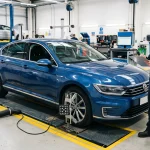
- Underbody Floorpan and Chassis Rail Symmetry: Place the vehicle on a hydraulic workshop lift. Measure diagonal cross-dimensions between front subframe mounting bolts and rear suspension pivot pins. Inspect factory seam sealer along the longitudinal chassis frame rails for cracks, uneven beads, or fresh underseal spray masking straightened metal.
Frequently Asked Questions
Can a completely free report tell me if a car was in a major accident?
Government registries (such as French Histovec or Polish CEPiK) log expert technical immobilizations resulting from severe road accidents. However, if a collision was repaired privately without police or insurance intervention, only a physical paint depth inspection and electronic module audit can uncover the repair.
What should I do if I unknowingly purchased a repaired total-loss vehicle?
Under European consumer protection directives, if a seller deliberately concealed prior structural frame damage, the buyer has the legal right to rescind the purchase agreement (rescission/cancellation) and demand a full refund based on fraudulent concealment (arglistige Täuschung).
Get our latest guides, news, and insights highlighted in your Google Search & AI Overviews.