✨ This article was AI edited. Editorial responsibility: VinCheckGermany.eu.
A Duitse kentekens check verifies German regional license plate codes (Unterscheidungszeichen), vehicle registration certificates (Teil I and II), and 17-character chassis numbers before importing an automobile into the Netherlands. This cross-border verification audits previous ownership counts, confirms municipal deregistration status, and verifies authentic TÜV inspection records to prevent purchasing fraudulent or clocked vehicles.
For motorists, automotive professionals, and commercial traders in the Netherlands, importing a pre-owned vehicle from Germany offers unmatched variety, competitive pricing, and high build specifications. However, the German registration system utilizes distinctive regional codes and administrative protocols that differ substantially from Dutch practice. Conducting a comprehensive duitse kentekens check enables buyers to decode German registration geography, verify ownership credentials, and avoid common cross-border import pitfalls.
Anatomy of German License Plates (Unterscheidungszeichen)
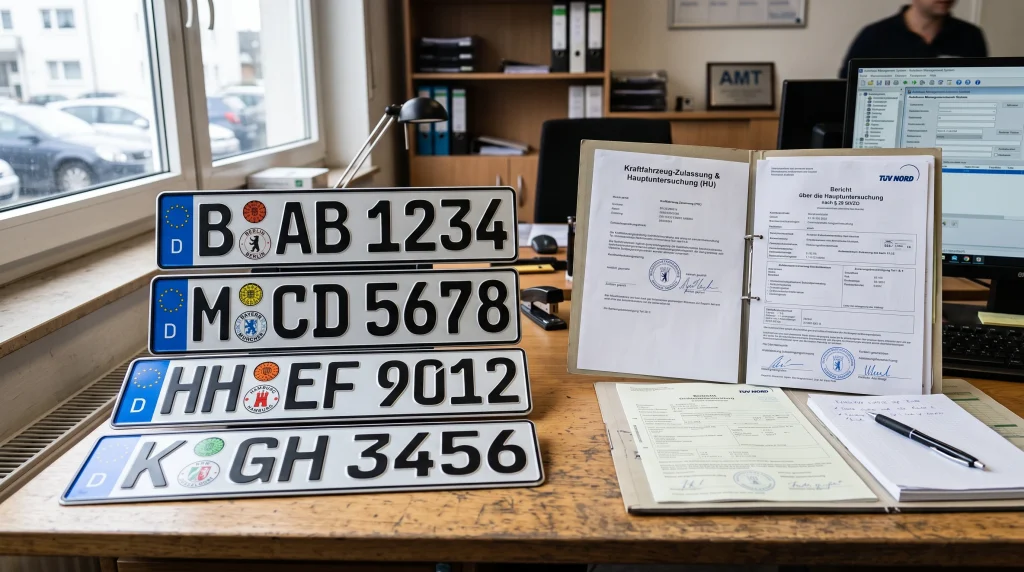
Unlike Dutch license plates which are assigned to a vehicle permanently without geographic distinction, German vehicle plates (Euro-Kennzeichen) immediately reveal the municipal licensing jurisdiction (Zulassungsbezirk):
- City / District Identifier (1 to 3 Letters): The initial letter cluster indicates the administrative district. As a general rule, major metropolitan centers feature single-letter codes (e.g.,
Bfor Berlin,Mfor Munich,Kfor Cologne,Sfor Stuttgart). Secondary cities feature two-letter codes (e.g.,DOfor Dortmund,BNfor Bonn), while smaller rural districts use three letters (e.g.,GAPfor Garmisch-Partenkirchen,WESfor Wesel). - State Sticker (Stempelplakette): Positioned on the lower section of the plate between the city code and the random alphanumeric block, this colored seal features the official coat of arms of the German Federal State (Bundesland) and authenticates active road registration.
- Inspection Decal (TÜV-Plakette): The circular sticker affixed to the rear plate indicates the exact year and month when the vehicle’s mandatory roadworthiness inspection (Hauptuntersuchung) expires.
Major German Regional Codes Relevant to Cross-Border Vehicle Buyers
Understanding the geographic origin of a German pre-owned car can provide valuable insights into its operational history and environmental exposure:
| Regional Prefix | Administrative District | Federal State (Bundesland) | Driving Environment Characteristics |
|---|---|---|---|
B | Berlin (Capital City) | Berlin | Dense stop-and-go urban traffic, higher clutch/brake wear, low average highway speeds. |
M | Munich (München) | Bavaria (Bayern) | Proximity to alpine highways; frequent road-salt exposure in winter; high-specification executive vehicles. |
HH | Free and Hanseatic City of Hamburg | Hamburg | Maritime coastal atmosphere, mixed urban/commuter mileage, modern fleet turnover. |
WI / DN | Wiesbaden / Düren | Hesse / North Rhine-Westphalia | Frequently utilized by major car rental fleets (Sixt, Europcar) for national fleet registrations. |
Why You Cannot Check German Vehicle History by Plate Alone
A crucial realization for Dutch buyers conducting a duitse kentekens check is that German license plates cannot be tracked across vehicle owners like Dutch plates:
- Plate Cancellation Upon Deregistration: When a car is sold or exported from Germany, the owner visits the Zulassungsstelle to decommission the vehicle. The registration badges are physically scraped off the plates, and the license plate registration is cancelled.
- Plate Reassignment: The former owner can immediately transfer their old plate sequence to a newly purchased vehicle, or the municipal authority can re-issue the plate to an unrelated resident after a statutory waiting period.
- The 17-Character VIN as Permanent Anchor: The Vehicle Identification Number (VIN / Fahrzeug-Identifizierungsnummer — FIN) is the only permanent, unalterable identifier. Entering the VIN into international vehicle databases retrieves the true historical timeline, including previous inspection mileage, factory options, and insurance claim history.
Verifying German Vehicle Ownership Documents (Teil I & Teil II)
When finalizing your transaction with a German seller, verifying the physical presence and authenticity of both official registration documents is critical for successful RDW registration in the Netherlands:
1. Zulassungsbescheinigung Teil I (Fahrzeugschein)
The green vehicle registration certificate. Check that:
- Field E matches the 17-character VIN stamped into the engine bulkhead or right suspension turret.
- Field B displays the accurate initial registration date.
- The document bears an official deregistration cancellation stamp (Außerbetriebsetzung) proving the car is legally cleared for export.
2. Zulassungsbescheinigung Teil II (Fahrzeugbrief)
The formal title certificate printed on watermarked security paper. Inspect the historical registration count (Anzahl der Vorhalter). If a vehicle is listed as having had a single owner, but Teil II documents multiple prior owners, investigate whether the automobile was registered to a rental agency or corporate leasing pool.
Frequently Asked Questions
Why do many German rental cars have “WI” or “DN” license plates?
Major car rental companies often register large corporate fleets in specific municipal districts (such as Wiesbaden for Enterprise or Düren for Hertz/Avis) due to favorable municipal administrative processing and fleet taxation structures.
Can I keep the German license plates when importing a car to the Netherlands?
No. Standard German license plates are cancelled and deactivated upon official deregistration in Germany. To drive the vehicle home, you must obtain temporary German export transit plates (Ausfuhrkennzeichen with a red date stripe) or transport the car on a flatbed trailer.
Erhalten Sie unsere neuesten Ratgeber, News und Analysen hervorgehoben in der Google-Suche und in AI Overviews.