✨ This article was AI edited. Editorial responsibility: VinCheckGermany.eu.
To check a VIN number in Germany, you audit a 17-character vehicle identification number against the Kraftfahrt-Bundesamt (KBA) recall database, German insurance total-loss records, and official TÜV roadworthiness test certificates. This comprehensive verification identifies unserviced manufacturer safety recalls, reveals structural accident histories, and confirms legal ownership before finalizing an international vehicle acquisition.
Germany’s automotive manufacturing reputation for exceptional craftsmanship and performance makes it the preeminent hunting ground for international pre-owned vehicle purchasers. However, navigating the German secondary automotive market requires an uncompromising verification methodology. Knowing how to systematically check vin number germany records prevents prospective buyers from inheriting expensive mechanical defects, undisclosed accident damage, or dangerous administrative title encumbrances.
The Kraftfahrt-Bundesamt (KBA) and Federal Recall Supervision
In the Federal Republic of Germany, vehicle safety and emission compliance are monitored by the Kraftfahrt-Bundesamt (KBA), based in Flensburg. When a critical mechanical or electronic safety defect is discovered, the KBA exercises statutory supervision over manufacturer recall campaigns:
- Mandatory Safety Recalls (Überwachte Rückrufe): These campaigns involve critical safety components (e.g., Takata airbag inflators, high-pressure fuel pump failures, braking hydraulic assist software). If an owner ignores repeated recall notices, the KBA orders the municipal licensing authority to forcibly decommission the vehicle (Betriebsuntersagung).
- Voluntary Service Campaigns (Freiwillige Kundendienstmaßnahmen): Minor software updates, corrosion prevention clips, or infotainment bug fixes conducted during routine scheduled dealer maintenance.
- Cross-Border Recall Implications: When purchasing an automobile in Germany for international export, verifying that all mandatory KBA recall campaigns have been executed is vital. If an unresolved recall remains on the chassis, your domestic licensing authority may deny initial roadworthiness registration until an authorized dealer certifies the repair.
Anatomy of the German Vehicle Identification Architecture
Every German vehicle adheres strictly to the international ISO 3779 standard, encoding detailed production parameters into its 17-digit sequence:
| VIN Position | ISO Section | German Automotive Meaning | Inspection Audit Value |
|---|---|---|---|
| Positions 1–3 | WMI (World Manufacturer Identifier) | Geographic region and manufacturer entity (e.g., WBA for BMW AG, WDB for Daimler-Benz, WVW for Volkswagen AG). | Verifies country of origin and genuine manufacturer pedigree versus counterfeit assembly. |
| Positions 4–9 | VDS (Vehicle Descriptor Section) | Body style, chassis generation, powertrain code, and passive safety restraint configuration. | Reveals engine displacement and factory chassis specification to prevent purchasing re-shelled cloned vehicles. |
| Position 10 | Model Year Identifier | Standard alphanumeric single-character code designating automotive engineering model year. | Prevents sellers from misrepresenting older inventory as newer face-lifted model generations. |
| Position 11 | Assembly Plant Code | Identifies the exact German assembly plant (e.g., A for Ingolstadt, F for Bremen, N for Neckarsulm). | Allows cross-referencing against manufacturer build sheets and factory delivery invoices. |
| Positions 12–17 | VIS (Sequential Production Number) | Unique six-digit serial sequence assigned as the chassis exits final assembly. | The primary database query key for digital service records, recall logs, and insurance claims. |
Verifying German Vehicle Ownership Documents (Teil I & Teil II)
German vehicle titles are among the most secure in the world, printed by the Federal Printing Office (Bundesdruckerei) on high-grade security paper containing multi-tone watermarks, security threads, and fluorescent fibers:
1. Zulassungsbescheinigung Teil I (Fahrzeugschein)
The vehicle registration card. Verify that the 17-digit VIN printed in Field E matches the physical bulkhead stamping exactly. Confirm that the document bears the official municipal seal of the registration office (Zulassungsstelle) and that the initial registration date in Field B corresponds to the seller’s representations.
2. Zulassungsbescheinigung Teil II (Fahrzeugbrief)
The ownership deed certificate. This document tracks the number of prior owners (Anzahl der Vorhalter). Meticulously compare the listed owner count with the seller’s advertisement. If an automobile is advertised as “single-owner” (1. Hand) but Teil II displays multiple prior registrations, investigate whether the vehicle was previously utilized as a rental vehicle (Mietwagen) or company fleet car.
Executing the Physical VIN Inspection Routine
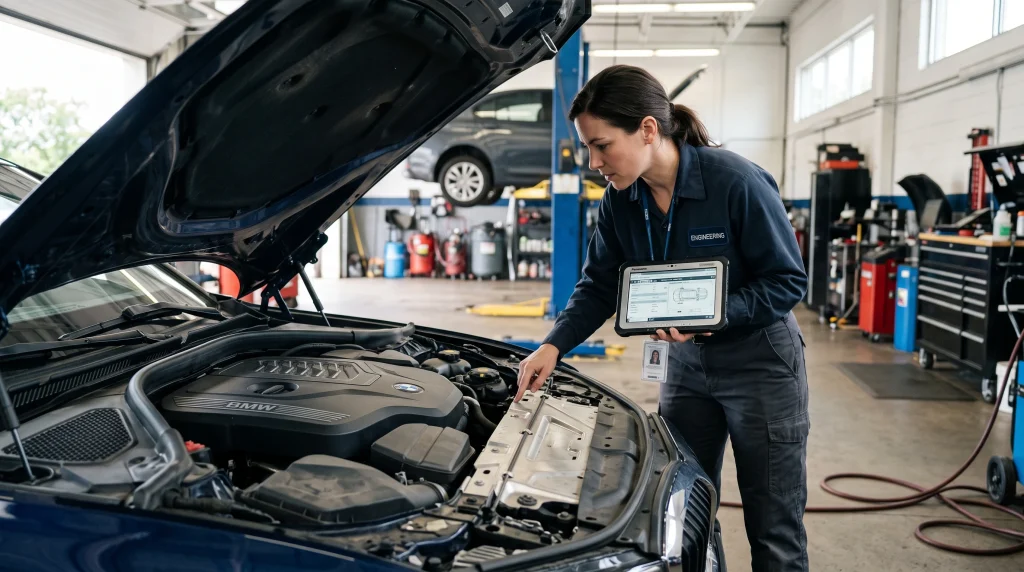
Never rely solely on digital reports or dashboard tags when evaluating a German automobile in person. Perform this comprehensive physical inspection protocol:
- Firewall Stamping Inspection: Clean the mechanical VIN stamped into the engine bulkhead using a micro-fiber towel and mild solvent. Inspect the characters under oblique LED illumination. The character edges must be razor-sharp with consistent strike depth. Any grinding marks, uneven spacing, or chemical etching indicates VIN manipulation.
- Driver B-Pillar Data Label: Verify the tamper-evident black holographic label on the driver’s door shut face. If the sticker exhibits peeling corners, wrinkled surfaces, or missing barcode sections, the vehicle may have undergone structural reconstruction following a severe side impact.
- Lower Windshield Tag: Check the optical VIN tag visible through the lower edge of the windshield glass. Ensure the glass itself displays authentic manufacturer logo etchings that correspond to the vehicle’s model year.
Frequently Asked Questions
Can I verify German manufacturer recalls without visiting a dealership?
Yes. Many major German automotive brands (BMW, Mercedes-Benz, Audi, Volkswagen, Porsche) offer online recall lookup tools on their customer portals where entering the 17-digit VIN immediately displays open safety recalls and technical service bulletins.
What should I do if a German car has an open KBA recall?
Request that the selling dealership execute the recall remedy at an authorized franchised service center prior to taking delivery. Manufacturer safety recalls are performed free of charge regardless of vehicle age or warranty status.
Erhalten Sie unsere neuesten Ratgeber, News und Analysen hervorgehoben in der Google-Suche und in AI Overviews.